
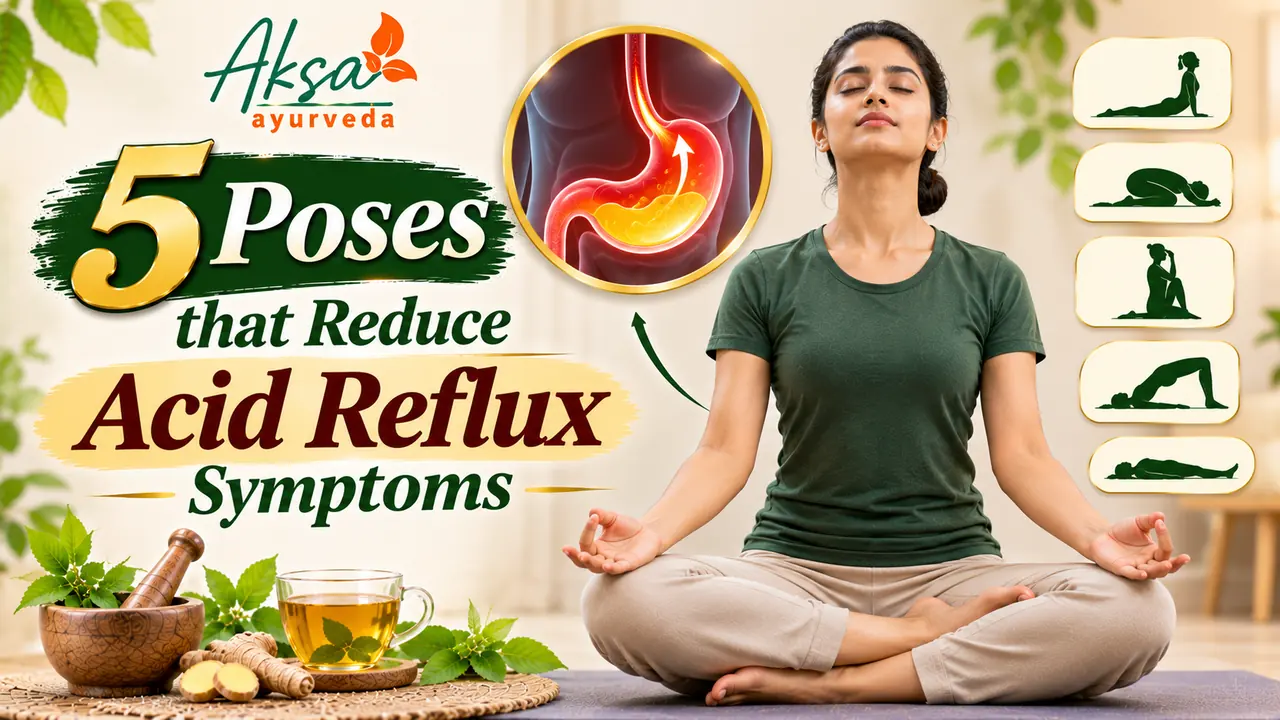
Acid reflux answers to position and breathing more than to effort. Five poses worth knowing, the ones that quietly make it worse, and when to stop.
Reflux happens when stomach contents move upward past the junction at the bottom of the food pipe. That junction is influenced by gravity, by pressure inside the abdomen, and by the tone of the diaphragm around it. This is exactly why asana and slow breathing can settle symptoms — and why a few popular poses do the opposite.
1. Vajrasana — kneeling, after the meal
- Kneel with the shins flat on the floor and sit back on the heels, spine tall, shoulders relaxed, hands on the thighs.
- Stay for 5 to 10 minutes after lunch and dinner. If the knees or ankles protest, place a folded blanket under the sit-bones, or sit on a low stool with the legs angled back instead.
- The upright, slightly compressed seated posture keeps the stomach above the junction and slows the pace of eating when it is done before and during a meal rather than only after.
- It is comfortable enough to become a habit, which is the main virtue of any reflux advice.
2. Lying on the left side
- Lie on the left with the lower knee bent and a pillow between the knees, and stay for 10 to 15 minutes rather than falling asleep mid-practice.
- On the left side, the stomach sits below the oesophageal junction and the acid has to travel uphill; on the right, the geometry works against you. This is the most physically straightforward of the measures here.
- The same logic applies at night: raise the head of the bed by 10 to 15 centimetres — blocks under the legs or a wedge under the mattress. Stack of soft pillows is worse than useless, because it bends the neck and crunches the abdomen while leaving the chest flat.
- Avoid lying down at all for two to three hours after the last meal. This single rule helps more people than any pose.
3. Sukhasana with diaphragmatic breathing
- Sit cross-legged on a folded blanket so the hips are slightly above the knees, spine long, one hand on the belly.
- Breathe in through the nose so the belly expands before the chest moves; exhale slowly and gently through the nose, letting the navel sink. Six breaths a minute is about right — roughly five seconds in, seven out.
- Five minutes, twice a day, and once during a symptomatic wave.
- Slow abdominal breathing increases the activity of the diaphragm crura that hug the lower oesophagus, and it settles the anxiety that makes reflux symptoms feel louder. It is the one practice here with real trial support behind it.
- Skip forceful breathing entirely. Kapalbhati and Bhastrika spike abdominal pressure and push contents upward — they are the classic mistake in reflux.
4. Setu Bandhasana, gently and away from meals
- Lie on the back, knees bent, feet hip-width and close to the buttocks. Lift the pelvis only a few centimetres, no higher, and rest the shoulders and head on the floor.
- Hold 20 to 30 seconds, lower slowly, repeat three or four times. Practise at least two to three hours after eating.
- A mild backbend with the chest above the stomach puts gravity on your side, and it opens the front of the ribcage, which most people with reflux have collapsed into a slouch.
- Do not roll a blanket under the neck, do not climb the pelvis high, and stop if there is any burning.
- If a full bridge is uncomfortable, the same benefit comes from lying with the upper body propped on a wedge for a few minutes.
5. A slow walk, and the poses that only stretch
- Ten to fifteen minutes of easy walking after the two larger meals is not a yoga pose in the classical sense and it is the most effective movement advice we give for reflux, gas and blood sugar together. A brisk walk, or one that involves climbing stairs, is too much on a full stomach.
- For the stiff upper back and shoulders that keep people folded forward: gentle cat-and-cow on all fours, a supported fish pose with a block between the shoulder blades, and a standing chest opener with hands clasped behind the back. Three to five slow rounds, three or four hours after eating.
- Mouth-watering (Vajrasana-adjacent) practices like Sheetali breathing suit a minority of people who find heat in the chest; if it feels calming, five rounds is enough.
Poses to leave out while reflux is active
- Anything inverted: legs up the wall, headstand, shoulder stand, a downward dog held for long. When the stomach is not empty, inversions remove gravity from the equation.
- Deep forward folds and seated twists pressed tightly against the belly, especially after meals.
- Core work that bears down: full sit-ups, crunches, plank holds to failure, boat pose. They raise intra-abdominal pressure, which is the mechanism you are fighting.
- Hot-room classes, where dehydration and heavy breathing make symptoms louder.
- Any practice done within two hours of a full meal.
The parts of the day that matter more than the mat
- Small meals; a heavy plate is the single largest trigger.
- Identify your own irritants rather than borrowing a list. The usual suspects are fatty and fried food, maida-heavy meals, strong tea and coffee on an empty stomach, cola, citrus, tomato, mint, onion and garlic in large raw quantities, alcohol and smoking. Nothing needs to go; the ones that reproducibly cause your symptoms do.
- No late dinner. Finish the last substantial meal three hours before bed.
- Weight around the abdomen pushes on the stomach; even modest loss changes night symptoms for many people.
- Loose waistbands, and not bending at the waist immediately after eating.
- A pillow, not a tablet, at the head of the bed if nights are the problem.
When poses are not the treatment
See a doctor without waiting for a retreat, and get investigated if:
- Symptoms come more than twice a week for several weeks despite all of the above.
- Swallowing has become difficult, painful, or food sticks partway down; or you have unintentional weight loss, vomiting, black stools, anemia, or a persistent hoarse voice or cough. These are alarm features and need proper assessment, usually including an endoscopy.
- Chest pain is pressure-like, comes with exertion, or spreads to the arm, jaw or back. Do not diagnose yourself with gas over chest pain.
- There is a known hiatal hernia, you are pregnant, or you have been taking acid-suppressing medication for months without review — long-term suppression has its own consequences and deserves a clinician's decision.
- Symptoms wake you nightly, or there is wheeze and cough suggesting acid is reaching the airway.
How we work with this at Aksa
Reflux is one of the most common complaints at our two centres, and the consultation is mostly about your day — meal timing, portion, sleep position, work stress, existing medicines and reports — before any prescription. We then combine dietary and routine correction with herbal preparations suited to the individual and a short asana-and-breathing plan you can actually keep to. Chronic, atypical or alarm-featured cases are referred for investigation, not held on herbs. If this has been running for months, bring your reports to either centre and let us look at the whole picture.
Related reading


Take the next step on your own case
Aksa physicians have been consulting on Ayurvedic care since 1992. Book a free video consultation and get a routine built around your digestion, sleep and history.