Model Town, Delhi
Third Floor, B-16, Above AU Small Finance Bank ATM, Derawal Nagar, Model Town, Delhi – 110009
Open all days
Timings and directionsDiabetes, arthritis, skin disorders & more! Get a free consultation with top Ayurveda doctors — 91 8826111667 | No travel, no waiting. Consult Aksa’s doctors from home via video call.

Type to search the whole site — use ↑ ↓ to move and Enter to open.
10 conditions we keep a page for
Autoimmune is one word covering something like a hundred different diseases, and the ten pages filed here are not mild variations on a theme. Vitiligo costs you pigment and, apart from the distress, nothing else. Lupus can take a kidney. Scleroderma can scar a lung. Ulcerative colitis can empty a colon. What they genuinely share is a mechanism: the immune system has lost tolerance to something that is your own. That single fact decides the whole treatment conversation, because the problem is not a weak immune system. It is a misdirected and over-active one. So nothing on this page will 'boost' your immunity - that is the wrong direction, and several of the preparations marketed as immunity tonics are precisely what the rheumatologist prescribing your medicines would rather you did not take. What a plan here does instead is the layer a fifteen-minute specialist appointment never has time for: sun and skin discipline, sleep and pacing, the diet that works around a steroid course or a colitis flare, comfort between flares, and the reporting literacy that makes you telephone your doctor on the right day instead of the wrong one.
Worsening symptoms in an autoimmune disease are not a flare to be waited out. Passing much less urine than usual with ankle swelling and a blood pressure spike; a sudden severe headache with blurred vision; breathlessness at rest or a new persistent dry cough; difficulty swallowing or raising your arms above your head; chest pain or fainting; blood in loose motions six or more times a day with fever; a single mouth ulcer that has not healed in three weeks in someone who smokes or drinks alcohol; a neck swelling that has grown over weeks with hoarseness, difficulty swallowing or a noisy breath; palpitations with weight loss, tremor and fever; a temperature over 38 C on steroids, a biologic or after chemotherapy; a hot swollen joint with fever; or a new painful red eye with blurred vision. Any one of those belongs in an emergency department today, not in a consultation slot. Tell us afterwards and the plan gets rebuilt around what happened.
Leave your name and number — a care coordinator calls you back and tells you what to bring.
Prefer to speak now? Call 91 8826111667
Each of these has its own page — symptoms, the Ayurvedic reading of the condition, what treatment looks like and the questions patients ask before they book.
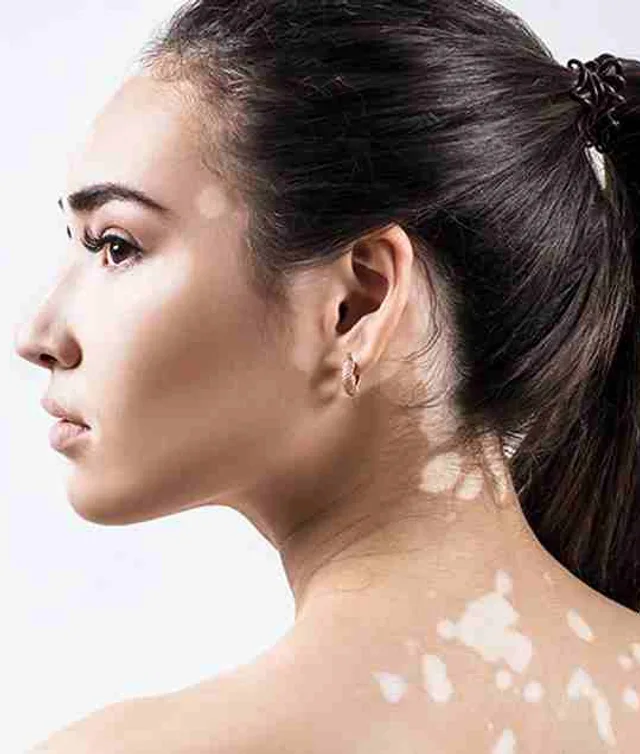
Melanocytes - the cells that make pigment - are destroyed in patches, leaving sharply outlined white areas, most visible on the face, hands, wrists and around body openings. It is not contagious, not an infection and not a fungus, and it is associated with thyroid disease, so a TSH belongs in every new case. The honest hierarchy of treatment: sun protection and camouflage, then topical steroids or tacrolimus for early and facial patches, then narrowband ultraviolet B, which is the intervention with the best evidence behind it, then surgical grafting for segmental disease that has been stable for a year. No tablet or powder repigments skin on its own. The page for this condition properly lives under skin disorders, and the link below redirects there.
Read this pageThe commonest reason anyone reaches for the word autoimmune here, and usually wrongly. Recurrent aphthous ulcers - small, round, yellow-based, painfully tender on the inner lip, under the tongue and on the soft palate - are not autoimmune in most people. Iron, vitamin B12, folate and zinc deficiency, a new toothpaste containing sodium lauryl sulphate, a sharp tooth edge, denture rub, coeliac disease, Crohn's, ulcerative colitis, lupus, Behcet's disease, herpes, and the blistering skin diseases can all do it, and stress and poor sleep make any of them more frequent. What separates a nuisance from a diagnosis is the pattern: how many, how long each lasts, whether they scar, and whether the eyes, genitals, skin, joints or bowels are involved too.
Read this pageAn eosinophil count above the reference range on a differential. In India the commonest cause by a wide margin is a worm infection, followed by asthma, eczema, hay fever and drug reactions - none of which are autoimmune. That matters because a dose of albendazole is a genuine cure for the majority of these people, and a course of herbal immunity tonics is not. The autoimmune and serious end of the list is real but narrower: allergic bronchopulmonary aspergillosis, EGPA and other vasculitides, adrenal insufficiency, hypereosinophilic syndrome and a handful of blood disorders. A persistently high count with breathlessness, chest pain, numbness, weight loss or a skin rash needs a physician's workup, not a wait.
Read this pageThe disease this whole field is named after: an over-active immune system forming antibodies against its own cell nuclei, and then depositing the complexes wherever blood flow is high - skin, joints, kidneys, blood counts, nerves, heart and lungs. Fatigue that is not fixed by sleep, joint pain with morning stiffness, a rash across the cheeks and nose that follows sun exposure, mouth ulcers, hair thinning, recurrent infections, swelling round the eyes or ankles and foamy urine are the usual early sentences. Hydroxychloroquine is the foundation of treatment and stopping it is how flares start. Kidney involvement is the part that decides prognosis and is managed by biopsy and immunosuppression.
Read this pageA hardening. The immune signal drives fibroblasts to lay down collagen, so the skin thickens and tightens - fingers first, then face and sometimes trunk - and the same process can affect the oesophagus, lungs, heart and kidneys. Raynaud's is usually the first symptom years before anything visible: fingers whiting then bluing then reddening in cold water or air conditioning. Reflux, a tight jaw, tendon friction rubs, finger-tip ulcers that will not heal, and a new dry cough with breathlessness on exertion are the things that get missed. Skin fibrosis is not reversed by anything available today; the treatments that work target the lung and the vessels, and the kidney crisis is an emergency measured in hours.
Read this pageMuscle inflammation with a skin signature: a violet-red lid swelling, knuckle papules over the joints, and a rash on the back of the shoulders and neck. The weakness is proximal and symmetric - difficulty standing from a low chair, climbing stairs, lifting arms to wash hair - and it is not the ache of overuse. Swallowing difficulty, a nasal quality to the voice, and breathlessness are the dangerous three, because aspiration pneumonia and respiratory muscle failure are how this disease kills. In an adult over forty a new diagnosis carries a real association with an underlying, sometimes silent, cancer, so age-appropriate screening is part of the diagnosis rather than an extra. Steroids and immunosuppression are the treatment.
Read this pageTiny clumps of immune cells called granulomas forming where they should not - in over ninety per cent of cases in the lungs and the lymph nodes of the chest, and also in the eyes, skin, nerves, heart, salivary glands, liver and kidneys. Persistent dry cough, breathlessness, weight loss, night sweats, a tender red lump on the shin, a painless red eye, a facial nerve palsy, raised calcium. The reassuring fact most people are not told: a large share of cases settle on their own within one to two years, and treatment is only needed when an organ is threatened. The dangerous minority is cardiac sarcoidosis, which presents as palpitations, fainting or heart block, and eye disease, which needs a slit-lamp examination rather than an opinion.
Read this pageInflammation confined to the lining of the large bowel, starting at the rectum and extending upwards in a continuous stretch. Its signature is blood: loose motions streaked or mixed with blood and mucus, urgency that cannot be deferred, pain low on the left, and getting up at night to pass stool. That last one is important - irritable bowel syndrome does not wake people from sleep and does not bleed. Diagnosis is colonoscopy with biopsies, not a symptom score, and infections including amoebiasis, C. difficile and intestinal tuberculosis have to be excluded before immunosuppression, because steroids given to intestinal tuberculosis make it far worse. Mesalazine is the foundation; a severe attack is an admission.
Read this pageA visible or palpable enlargement of the thyroid gland in front of the neck. Most goitres in India are not autoimmune at all - they come from iodine deficiency, from multinodular change with age, or from Hashimoto's thyroiditis. The page exists because people search for it, and because a neck swelling has a correct pathway: TSH and free T4, an ultrasound describing size, nodules and vascularity, a needle biopsy of anything suspicious, and then either observation, thyroid hormone, radioiodine or an operation. Aksa does not treat thyroid disorders and no herbal preparation here shrinks a gland. A swelling that grows quickly, feels fixed, hoarsens the voice, or makes breathing or swallowing noisy needs an ENT or endocrine surgeon this week.
Read this pageThe commonest cause of an overactive thyroid: antibodies against the TSH receptor that keep the gland switched on regardless of what the body needs. Weight loss with a good appetite, heat intolerance and sweating, a racing or irregular pulse, tremor, anxiety, loose stools, thinning hair, sleeplessness, and in some people eye disease - grittiness, double vision, bulging. Left untreated it causes atrial fibrillation, heart failure and bone loss, and occasionally thyroid storm, which is a lethal emergency. Carbimazole, radioiodine or surgery are the treatments, and none of them is replaced here. Two safety points every patient should know cold: fever with a sore throat on carbimazole means stop and get a blood count the same day, and smoking makes the eye disease worse.
Read this pageNot sure which page is yours? Browse all 160 conditions or send the report to a physician.
The first job here is a sorting job, and it happens twice. First: is this actually autoimmune? A high eosinophil count in a Delhi office worker is usually a worm, a mouth ulcer is usually iron or a sharp tooth, a neck swelling is usually iodine, and half of what arrives labelled autoimmune has a completely different explanation waiting in a blood test. Second: if it is autoimmune, what has the specialist already established, and what is the medicine list? A plan built without knowing your hydroxychloroquine dose, your steroid course and your last creatinine is not a plan. Where the diagnosis is settled, our work sits beside the treatment that is holding the disease down - never in place of it, and never as a reason to shorten a prescription.
Name, number, the diagnosis you were given or suspect, who gave it, how long you have had it, which organs have been involved, every medicine and dose you are taking now, and the reports you already hold. A care coordinator calls back, tells you exactly what to bring and what to stop doing before the visit - and if the picture you describe sounds like an emergency, that call ends with a direction to a department rather than a slot.
At the Model Town or Burari clinic with a B.A.M.S physician, or on a video consultation where the question is a report you do not understand, a symptom that has changed, or a plan you want reviewed between rheumatology visits. Some things genuinely need an in-person visit: a new neck swelling, a non-healing mouth ulcer, finger-tip ulcers, new breathlessness, a rash being started on immunosuppression, or any decision about tapering a medicine.
Which symptom came first and in what order, since when, what has been tested and what it said, sun exposure and occupation, cold exposure and Raynaud's, swallowing and chewing, bowel frequency and blood, night symptoms, weight, hair, eyes, joints and morning stiffness, pregnancies, infections, vaccinations, every medicine including painkillers and herbal powders, and the family history. Then the documents themselves, read as a series rather than a snapshot: antibodies and titres, complement levels, counts, protein in urine, lung function, imaging, biopsy and colonoscopy reports with dates.
Written in two columns: what belongs to rheumatology, gastroenterology, nephrology, endocrinology or dermatology and does not move, and what we can actually add - sun and skin protection, sleep and pacing, the diet around steroids and around a flare, comfort measures, nutritional repletion where a deficiency is measured, and the symptom layer between flares. Anything we prescribe is listed with its full composition so your specialist can see it, and nothing is started that we would not show them.
Not on how you feel in the waiting room. Complement C3 and C4 and anti-dsDNA titre and urine protein in lupus, faecal calprotectin and symptom score and, on schedule, colonoscopy in colitis, absolute eosinophil count, lung function with DLCO and imaging in sarcoidosis and scleroderma, muscle enzymes and swallow and vital capacity in myositis, TSH and free T4 in thyroid disease, bone density and vitamin D and sugar on any steroid course. If the direction of travel changes, the specialist is told the same week.
Autoimmune reports are misread in one direction far more than the other: a positive antinuclear antibody treated as a diagnosis when it is present in a meaningful share of perfectly healthy people, and a normal CRP treated as reassurance when the disease in front of you does not raise CRP. Bring every printed report with its date and reference range, in order. The sequence is the information - a single value tells us almost nothing about a disease that moves in flares.
None of this is ordered as a package, and most of it is already being done by your specialist - bring it rather than repeating it. A test is asked for here only when the answer would change what we do, and we will tell you which of your reports are still valid instead of charging you twice. Government and municipal facilities in Delhi supply blood counts, thyroid assays, chest imaging and colonoscopy at low or no cost, and a rheumatology, gastroenterology or endocrinology outpatient department will see an unconfirmed diagnosis without a referral from us.
The two things that cause most of the harm in this field are both avoidable with plain information: an immunosuppressant stopped because somebody promised a cure, and a serious diagnosis waited out on a course of immunity tonics while an organ was being lost. What follows is what a plan at Aksa changes and what it does not, written so that you can judge any clinic against it - including ours.
Autoimmune disease is managed over years, not courses, and the difference between a good decade and a bad one is almost always the same short list: the right medicines kept going, the sun and cold avoided, the screening tests done on schedule, infection caught on day one, and the specialist told about everything else you are taking. A plan here earns its place inside that list, not around it.
B.A.M.S physicians at the two Delhi clinics. Consultation is with one of them, not with a counsellor.
 Dr. Md Faizan SiddiquiB.A.M.S · 6 Years ExperienceGastrointestinalSkin
 Dr. Raj AryanBAMS · 4+ Years ExperienceSkin & Dermatological ConcernsDigestive & Gastrointestinal Disorders
 Dr. Rupender S. KaushikB.A.M.S · 4 Years ExperienceJoint Pain
 Dr. Mohd SaqibB.A.M.S · 6 Years ExperienceDigestiveSkin
 Dr. Uvais NaeemBAMS · 1 Year of Clinical ExperienceDigestive & GastrointestinalSkin & Hair
Two clinics in Delhi, or a video consultation from anywhere in India.
Third Floor, B-16, Above AU Small Finance Bank ATM, Derawal Nagar, Model Town, Delhi – 110009
Open all days
Timings and directions2nd Floor, PVT. 449, KH. No. 137/5/11, Block B, Sant Nagar, Burari, Delhi – 110084
Open all days
Timings and directionsSpeak to the physician from home, with your reports on screen. Prescribed medicines are delivered across India.
How a video consultation runsThis is the most common question on this page and it contains the mistake that causes most of the harm. In an autoimmune disease your immune system is not weak - it is misdirected and over-active, attacking tissue that is your own. The entire treatment strategy in modern medicine is to quiet it down and make it more specific, not to rev it up. So an 'immunity booster' is aimed in exactly the wrong direction. Some of these preparations, giloy and ashwagandha among them, have documented immune-stimulating activity in laboratory studies; none has been shown in a human trial to induce remission in lupus, colitis, scleroderma or any other disease on this page, and several can interact with the medicines that are protecting your organs. What is worth doing instead is unglamorous and genuinely evidence-based: enough sleep, adequate protein and calories, vitamin D if a level is low, vaccinations on schedule, hand hygiene, no smoking, and treating an infection early. If someone has told you that your immunity needs building, ask them what your complement levels and your blood counts are.
The same structure on every category: real pages, written by the physicians who treat them.
Medical disclaimer: this page is educational and is not a substitute for professional medical advice, diagnosis or treatment. Systemic lupus erythematosus, scleroderma, dermatomyositis, sarcoidosis, ulcerative colitis, the autoimmune blistering diseases and vasculitides are managed by rheumatology, gastroenterology, pulmonology, nephrology and dermatology services, and corticosteroids, hydroxychloroquine, immunosuppressants and biologics are not replaced, reduced or stopped by Ayurvedic treatment. Thyroid disorders including goitre and Graves' disease are not treated at Aksa and belong to an endocrinologist or thyroid surgeon. Seek emergency care for fever on immunosuppression, fever with sore throat on antithyroid drugs, reduced urine output with a blood pressure spike and headache, breathlessness at rest, chest pain or fainting, difficulty swallowing, severe colitis with blood and fever, a new painful red eye, a hot swollen joint with fever, confusion or seizure, or a rapidly enlarging neck swelling with hoarseness or noisy breathing.
A consultation with a B.A.M.S physician who will ask which antibody, which organ and which dose before saying anything about a herb - a plain-language reading of your ANA, complement, counts, calprotectin, lung function or biopsy, an honest account of what a plan here can add to your specialist's treatment and what it must not touch, and a full written composition list for anything we give you to hand to your rheumatologist, gastroenterologist or endocrinologist.