
Sciatica: diet and lifestyle changes that actually help

Leg-path pain from the back is not treated by the leg. What changes the course is how you sit, walk, sleep and lift through the first six weeks — and what you stop doing.
Sciatica is a description, not a diagnosis: pain travelling from the buttock down the back or side of the leg, sometimes below the knee, often with tingling or numbness. The usual cause is a disc or a narrowed canal pressing or irritating the nerve root in the lower back. Most cases settle without surgery. The ones that do not usually had something else going on — a true canal problem, a dropped foot, or six weeks of the wrong rest.
First, the two things that decide everything
- Whether the foot can lift, whether there is numbness in the saddle area, and whether urine or stool control has changed. Any of those is same-day specialist care, not a routine question.
- How long it has been. Pain under six weeks behaves very differently from pain at four months, and the plan should change with the clock.
- Imaging is not the first step. An MRI is right when there is weakness that is worsening, bladder involvement, fever, cancer history, severe trauma, or pain that refuses to improve after six to eight weeks of proper conservative care.
Positions and habits that load the nerve
- Soft sofas, low chairs and floor sitting with crossed legs: the pelvis rolls back, the disc takes the load and the nerve gets it second-hand.
- A chair with no back support and a laptop on the lap, held for four hours with no standing break.
- Two-wheeler rides on broken roads, and long bus journeys with a bag on the lap.
- Bending and twisting together to lift a bucket, a child or a gas cylinder — this is the movement most acute attacks trace back to.
- Sleeping curled on the stomach with the neck turned; better on the side with a pillow between the knees, or on the back with a pillow under them.
- Sitting on a toilet seat for twenty minutes with a phone, which is a strange way to spend the day and a real way to keep the pelvis stiff.
The first six weeks, in plain order
- Keep moving. Bed rest beyond two days makes the outcome worse; the honest instruction is short bouts of walking, several times a day, as far as pain allows.
- Positions of relief: lying on the back with knees supported, on the side with a pillow between the knees, or gently on the elbows if that centralises the pain out of the leg.
- Direction matters. If repeated gentle extension moves the pain up out of the leg towards the back, that is a good sign and the physiotherapist builds on it. If a movement sends pain further down the leg, stop it.
- Nerve gliding done gently, not forced stretching of the hamstrings — pulling a sensitised nerve makes it angrier.
- Medicine for a defined short course with food, chosen for the stomach, kidneys and blood pressure, and no self-injected painkillers.
- Heat for the stiff muscles, cold for the sharp flare, and oil massage on the buttock and thigh muscles rather than on the spine itself.
- Work adjustments written down: chair height, footrest, a standing break every forty minutes, no lifting from the floor.
- Review at four to six weeks. Better: continue. Same or worse with a growing numb patch or weak foot: escalate, and the escalation is an orthopaedic or neurosurgical opinion, not another churn.
What diet, weight and smoking actually change
- Weight carried in the belly tilts the pelvis forward and loads the lower discs; slow loss with walking is the mechanical help that nobody prescribes.
- Smoking narrows the small vessels that feed the disc, slows healing, and is one of the clearest predictors of a bad back outcome. This is not a moral lecture, it is blood supply.
- Diabetes and long-standing sugar problems make nerves more sensitive and recovery slower; the HbA1c belongs in the plan.
- Protein and vitamin D are the boring part of the story: muscle that holds the spine, and bone that tolerates load. Test rather than dose blindly.
- Fluid and fibre so that straining does not add pressure to an already irritable nerve; constipation makes sciatica worse in a way patients rarely connect.
- Alcohol at night fragments sleep and lowers pain threshold, which shows up as a worse next day.
Where Ayurveda honestly helps
- Oil application and gentle massage on the muscles around the hip and thigh, warm sittings, and the morning stiffness routine — real comfort, modest effect.
- Gentle practice: slow walking, easy stretching, breathing practice for the muscle-guarding that comes with pain.
- Formulations are supportive for a defined period and should be prescribed by a qualified practitioner, not bought loose; anything unlabelled that gives fast relief is likely to contain a hidden painkiller or steroid.
- What we do not do here: cleansing procedures and forceful manipulation of the spine. Jerking the neck or lower back to 'put the disc back' has caused permanent nerve damage.
- The honest limit: no oil, churn or capsule removes a fragment of disc that is compressing a nerve, and none of them reverse a narrowed canal. They change pain, muscle guarding and daily function, which is worth a great deal — as long as it is not sold as a cure.
When to be seen urgently
- The foot slaps, the big toe will not lift, or weakness is increasing day by day.
- Numbness around the buttock and inner thighs, difficulty starting urine, or leakage — emergency, same hour.
- Fever with back pain, night pain that does not change with position, weight loss, or pain after a fall in someone over sixty.
- Cancer history, tuberculosis history, long-term steroid use, or blood thinners with severe new back pain.
At our two centres
- Model Town and Burari, first consultation free. We map where the pain travels, test the strength and reflexes, look at the chair, the bed, the lifting and the two-wheeler, and set a six-week plan with walking, positions, medicine timing and a physiotherapy referral.
- We refer for MRI and for a surgical opinion when the clock or the nerves say so, and we say it plainly rather than extending the trial of home care by another month.
The week that hurts most, hour by hour
- Do not lie down all day. Alternating twenty to forty minutes on the back with the knees supported and a short flat walk is what keeps the nerve from settling into stiff tissue.
- Warmth on the spasm beside the spine rather than on the leg itself, and a change of position before the pain changes, not after it.
- Standing for two minutes every working hour. The disc loads on sitting, and the hour you skip is the one that bites at ten at night.
- Sleep on the side with a pillow between the knees or on the back with one under them; a twisted mattress means a bad night and a worse morning.
- If pain travels further down the leg after an activity, that activity was too much. If it comes with new weakness in the foot or the thigh giving way, that is a call to the doctor the same day.
Back to work, driving and the gym
- Sitting work: a chair that supports the lower back, feet flat, screen at eye height, and an alarm for the hour instead of trust in memory.
- Driving: short trips first, a lumbar support, and no long highway day in the first month.
- Lifting: load close, knees bent, no twist while rising. A bucket or a child twisted the wrong way is the most common restart.
- The gym returns in order: walking and pool, then hip and core work, then machines with someone watching, then free weights. Deadlifts and sit-ups are the last things back, not the first.
- Smoking earns its place on this page because it slows the fluid supply to the disc and the healing of the nerve covering, which is why quitting shows up in the six-week graph before it shows up on the heart one.
Every individual is different. Before starting any new remedy, exercise or routine, please consult a qualified doctor, especially if you have diabetes, take blood thinners, or have had previous spine treatment.
Related reading
Fatty liver: the lifestyle and diet changes that reduce it
Read
5 lifestyle changes that improve erectile function naturally
Read
Acid reflux: which foods actually help
Read
Jaundice: diet and lifestyle advice for recovery
Read
Piles: 10 things that actually help at home
Read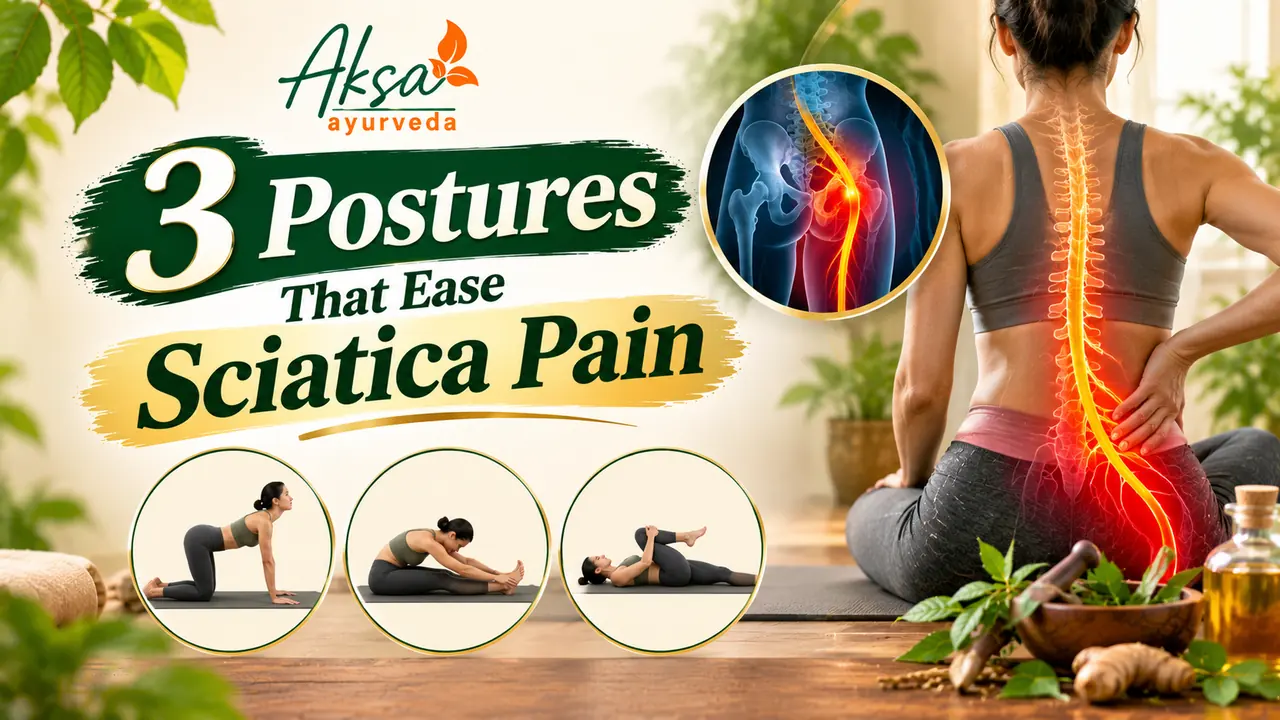
3 postures that ease sciatica pain
ReadTake the next step on your own case
Aksa physicians have been consulting on Ayurvedic care since 1992. Book a free video consultation and get a routine built around your digestion, sleep and history.