
Shortness of breath while climbing stairs: what Ayurveda does
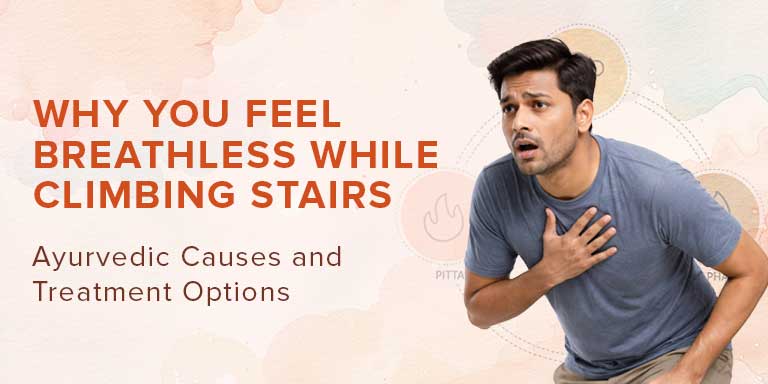
The question patients ask is not what is causing it. It is what we are actually going to do. Here is the honest split between what Ayurvedic treatment changes in breathlessness and where it changes nothing.
One word first. Breathlessness on the stairs has already been mapped once on this site — the systems behind it, the tests, the red flags. That article is the diagnosis side. This one is the treatment side, and it starts where diagnosis ends: with the cause in front of us.
The rule that decides everything
Ayurvedic treatment helps the causes that are metabolic, functional and reversible. It does not help the causes that are structural. That is the entire rule, and a clinic that cannot say it in one sentence is selling you something.
Reversible, and usually responsive: excess weight, a deconditioned body, a breathing pattern that has trained itself to be shallow and fast, reflux irritating the airways, chronic rhinitis and post-nasal drip, the airway inflammation left behind after repeated chest infections, dietary anaemia that we correct with food and with supplementation alongside your doctor, and the breathlessness that comes with anxiety or with recovery from illness.
Structural, and not responsive: a narrowed aortic valve, heart failure with a weak pump, high pressure in the arteries of the lung, a clot in the lung, established COPD with destroyed air sacs, scarring in the lung tissue, and anaemia from kidney failure or from hidden bleeding.
The second list is not short and it is not rare. It is exactly why a plan written before testing is a gamble with your time.
What we actually change
- Weight, treated as the main variable rather than a side note. Fat around the abdomen lifts the diaphragm and makes the chest wall heavier to move. A 7 to 10 percent reduction measurably improves breathlessness and liver fat at the same time. A crash diet achieves neither and costs you muscle.
- The food pattern instead of a food list. Real proportions, protein at every meal, less fried and less refined, eaten at hours the gut can actually handle. This is where Ayurvedic dietetics is genuinely useful, and also where it is most often oversold.
- A walking schedule with a number in it. Not walk daily, but a distance, a pace, and roughly a 10 percent increase each week. The staircase is the test, so the staircase can also be the training.
- Breathing pattern. A surprising number of people with unexplained breathlessness are breathing too fast and too high in the chest. Slow nasal breathing driven from the belly, ten minutes twice a day, does more than most supplements on the shelf.
- Reflux, rhinitis and sinus drainage. These three are the most commonly missed contributors, and the most commonly ignored by anyone treating only the lungs.
- Sleep, and the state of the nose at night. A person who cannot breathe through the nose will not train well, will not recover well, and will blame the wrong thing for the tiredness.
Where herbs sit in this
Herbs are the smallest lever in the plan, not the biggest. A few have modest evidence as airway and inflammatory support, and we use them as support, never as the answer. None of them opens a valve, replaces red cells, or reverses scarring.
Two practical cautions. First, a syrup that lets someone breathe slightly better for two months is precisely how a treatable cause gets missed. Second, herbal preparations bought outside a regulated supply have, in published testing, occasionally carried lead, mercury or arsenic. We do not send people off to buy unlabelled powders, and we would much rather you asked us first.
What we do not do
- We do not promise a lung detox. There is no such process to run.
- We do not stop anyone's inhaler, cardiac medicine or steroid. Where the cause is cardiac or pulmonary, our work runs alongside the physician's treatment, not instead of it.
- We do not write a plan before the basic work is done: haemoglobin, blood pressure, blood sugar, an ECG, and spirometry when the pattern points at the airways.
- We do not meet a falling stair tolerance with diet advice. That person gets tested and referred inside the same week.
Why the same symptom needs two different plans
Two people can climb the same flight of stairs, both come out breathless, and need opposite care. One has an aortic valve that has narrowed with age and a heart that cannot fill properly; the other weighs 95 kilos, sleeps badly, refluxes at night and has not walked anywhere in three years. The first needs a cardiologist this week. The second needs a plan with numbers in it and ten weeks. The symptom is identical. Nothing else about the two cases is.
That is why we will not tell you what to take before we know which of the two you are. It is also why the breathlessness that arrives slowly over two years is usually more treatable, and the breathlessness that arrives over two days is usually more dangerous.
What the first visit actually decides
- Whether the pattern is stable or falling. Stable and falling are different conversations.
- Whether the basic numbers are there: haemoglobin, blood pressure, blood sugar, an ECG, and spirometry if the airways are implicated.
- Whether the answer is likely metabolic and functional, or structural and referral-bound.
- Whether anything on the red-flag list is present, in which case the visit ends with a direction rather than a prescription.
Most people arrive with reports from someone else. We read them in this order, and we say plainly at the end of that first visit which of the two plans above you are in.
The timeline, honestly
Where the cause is weight, deconditioning, reflux or breathing pattern, people notice a difference between six and ten weeks, and the staircase is the measure of it. Anything promised faster than that is usually not a treatment effect — it is reassurance, which feels good and changes nothing.
Signs to stop and get checked now
- Breathlessness that came on over hours or a single day, or that is present while sitting still.
- Chest pressure, pain spreading to the arm or jaw, or sweating that arrives with the breathlessness.
- Swollen ankles, needing more pillows to sleep, or waking at night gasping for air.
- Coughing blood, fever with the breathlessness, or one calf that is swollen, hard and painful.
- Breathlessness with a bad headache, or lips and fingers turning grey-blue.
At our two centres
- Model Town and Burari, first consultation free. We take the pattern in order, do the basic examination and blood work, and put the cardiac and lung questions to a physician or pulmonologist the same week.
- Where the cause is weight, deconditioning, reflux, rhinitis or breathing pattern, we write the plan, put numbers on it, and review the staircase every few weeks. Where it is not, we tell you early, because that is the part that protects you.
Every individual is different. Before trying any new remedy or routine, please consult a qualified Aksa Ayurvedic doctor so the guidance can be personalised to your body constitution and health condition.
Related reading

Breathless on one flight of stairs? It isn’t only fitness
Read
सीढ़ियाँ चढ़ते समय साँस फूलना — किसे early warning मानना चाहिए
Readहड्डियों की कमज़ोरी के शुरुआती संकेत और आयुर्वेदिक दृष्टिकोण
Readलंबे समय से चल रही खांसी कब ब्रोंकाइटिस बनती है — शुरुआती संकेत
Read
Why you feel bloated even after light meals
Read
ब्रोंकाइटिस और अस्थमा में फर्क — आयुर्वेद से दोनों का इलाज
ReadTake the next step on your own case
Aksa physicians have been consulting on Ayurvedic care since 1992. Book a free video consultation and get a routine built around your digestion, sleep and history.