
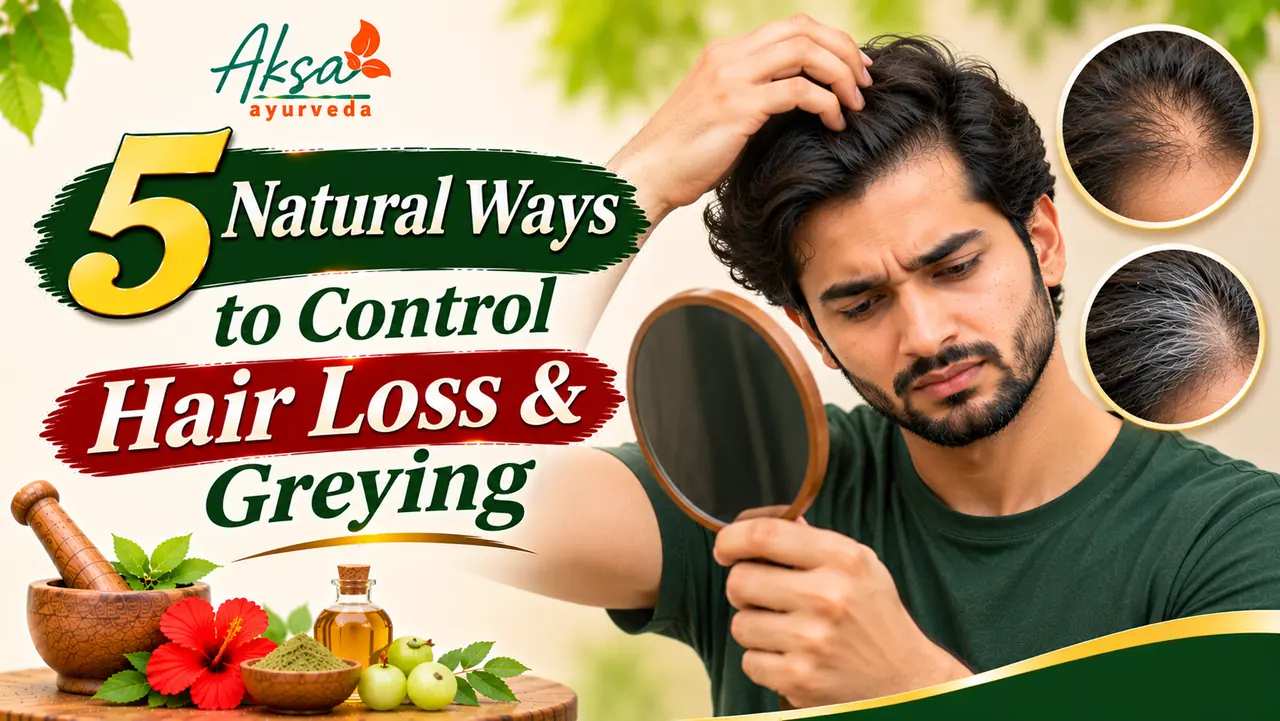
Hair fall is usually a signal about the body rather than the shampoo. Five things that genuinely change the pattern, and what no oil can fix.
The previous article in this series covered the topical side — the oils, the massage, what they are and are not worth. This one is about the internal and habitual causes, because in our clinic those explain a great deal more shedding than anything applied to the scalp. Hair is one of the few tissues that visibly records what has happened to the body three months ago, so the first job is to look backwards.
1. Find out which kind of loss you have before treating it
- Fifty to a hundred hairs a day is normal shedding. A handful in the drain after a wash is not automatically a disease, and much of the anxiety in this complaint is aimed at ordinary cycling.
- Diffuse loosening all over the scalp, beginning two to four months after a fever, surgery, delivery, rapid weight loss or a period of severe stress, is the classic picture of telogen effluvium. It usually settles on its own once the trigger passes — which is why almost every remedy appears to work at month six.
- Progressive recession at the temples and crown in a man, or widening of the part with the hairline preserved in a woman, is androgenetic alopecia. That is a genetic, hormone-driven process, and no diet or oil reverses it. It has established medical treatments, and the earlier they start the more hair they preserve.
- Round, smooth bald patches suggest alopecia areata; an itchy, scaly, weeping or pustular scalp suggests infection or dermatitis and needs that treated first. Both are doctor cases, not home cases.
- A simple self-check: part the hair under a bright light and compare with a photograph from six months ago. Change in the width of the part and in density at the crown tells you more than counting hairs in the brush.
2. Eat enough protein, and stop the crash diet
- The follicle is one of the fastest-dividing tissues in the body and it is the first thing the body economises on when calories or protein fall short. Shedding from a restrictive diet typically begins two to three months in, which is exactly when the diet is being praised.
- A realistic Indian-vegetarian problem is a day built on rice, roti and tea with very little actual protein. Dal twice a day contributes less protein than most people estimate.
- Working targets: a palm-sized portion of protein at both main meals — egg, fish, chicken, paneer, curd, soya, sprouts, dal in quantity — and roughly one gram of protein per kilogram of body weight a day for an otherwise healthy adult. Those with kidney disease need their doctor to set the number, not the internet.
- Iron matters disproportionately in menstruating women. Heavy periods, fatigue, breathlessness on stairs, pale inner lids and brittle nails together are a reason to check haemoglobin and ferritin rather than to change shampoo. Low ferritin with a normal haemoglobin still produces shedding, and it is missed constantly.
- Vitamin B12 is genuinely low in long-term strict vegetarians and in people on metformin; vitamin D deficiency is common enough that a low level surprises nobody. Both deserve a test rather than a guess, and both correct cheaply once measured.
3. Fix the thyroid, the sugar and the medicines
- Both underactive and overactive thyroid cause diffuse hair loss, often with a change in texture. It is one of the first things we check in a woman with shedding and fatigue, and hair generally recovers once the thyroid is treated properly.
- Poorly controlled diabetes, PCOS with its androgen excess and hair thinning, and postpartum hormonal collapse are all common internal causes. PCOS in particular produces a female-pattern thinning along with irregular cycles, acne and unwanted hair elsewhere — that combination needs an endocrine assessment, not a serum.
- Review the medicine cabinet. Blood thinners, acne isotretinoin, some beta blockers, lithium, certain antidepressants, antithyroid drugs, valproate and chemotherapy all list shedding. Never stop a prescribed medicine for this reason; ask the prescriber whether an alternative exists.
4. Change what you do to the hair itself
- Traction is an under-diagnosed cause and one of the few that is entirely self-inflicted: tight ponytails, buns, braids kept in for weeks, heavy extensions, and the comb pulled through wet hair. It produces loss at the temples and hairline that becomes permanent once scarring starts.
- Wear hair loosely, vary the parting and the position of a ponytail, detangle with a wide comb on damp rather than soaking hair, and let extensions rest between fittings.
- Heat and chemistry do the rest: frequent straightening, blow-drying on high, bleaching and rebonding break the shaft rather than the follicle, so the hair thins by snapping rather than falling. Reduce the frequency, use the lowest effective heat, and stop the process on any day the scalp stings, reddens or blisters.
- Shampooing daily does not cause loss; leaving a oily, dandruff-heavy scalp unwashed for weeks makes inflammation and itching, and itching means scratching and broken hairs. Treat dandruff as a scalp condition needing an antifungal wash, not as dryness to be oiled.
- A sun-protective hat for prolonged exposure, and rinsing salt or chlorinated water out promptly, are small measures with real effects on shaft quality.
5. Sleep, stress and the six-month rule
- Chronic sleep shortfall and sustained stress raise shedding through the same mechanism as any other physiological load on the body, and they worsen the itch-scratch cycle of every scalp condition. This is the least impressive advice in the article and among the more consistently useful.
- Quit smoking. It is a vasoconstrictor, and the follicle is a vascular organ; smoking is associated with earlier greying as well as with pattern loss.
- Expect a lag. Whatever the cause, a change made today shows at the scalp in roughly three months, because of the growth cycle. Anyone who has tried an oil for a fortnight and given up has not tested it; equally, anyone who credits a new oil for what was a self-limiting telogen effluvium has been fooled by the same cycle.
- Photograph the same parting, in the same light, every month. That beats memory every time.
On greying specifically
- The honest position: grey hair means the pigment cells in that follicle have stopped working. Genetics sets the timetable for almost everyone, and smoking accelerates it.
- A minority of early greying — particularly before twenties, or with patchy loss of colour along with other symptoms — has a findable and sometimes correctable association: vitamin B12 deficiency, thyroid disease, iron deficiency, and premature vitiligo-related depigmentation. Those deserve investigation because they matter for more than the hair.
- Beyond correcting a genuine deficiency, no diet, oil, powder or supplement has been shown to repigment hair that has already turned. Bhringraj, amla and curry-leaf oil condition the shaft and may slow breakage; they do not restore pigment. Any product promising to reverse grey hair permanently is a cosmetic claim, not a medical one.
- If a change in hair colour came on suddenly, along with pale patches of skin, or with fatigue and weight change, get that assessed rather than dosed.
When to stop self-treating and be examined
- Loss in distinct patches, or loss of eyebrow and lash hair.
- A red, scaly, painful, pustular or weeping scalp; black dots and broken hairs in a child, which suggests ringworm and needs prompt oral treatment to prevent permanent loss.
- Shiny, smooth areas where follicle openings have disappeared — scarring alopecia is a dermatology urgency.
- Shedding that continues beyond six months, or any hair loss with fever, weight loss, menstrual disturbance, or fatigue.
- Sudden heavy shedding after a new medicine.
At Aksa
Hair complaints at our two centres are assessed as a medical history first: what happened three months ago, what you eat in an ordinary day, your cycles, your medicines, your family pattern, and your scalp under good light. Blood work — haemoglobin, ferritin, thyroid, B12 and vitamin D where the picture suggests them — is ordered on the basis of that history, not as a package. Treatment then addresses the cause, adds internal and external herbal support suited to the individual, and states plainly what to expect and by when. Androgenetic, scarring and infective loss are referred to a dermatologist, because those are the patterns where delay costs hair permanently. Book a consultation at either centre with any previous reports.
Related reading

3 Ayurvedic remedies to control hair loss
Read
Dandruff, hair loss and early greying: treating all three
Read
Hair loss and early greying: 5 natural remedies
Read
7 home remedies to reduce hair loss and grow hair back
Read
Foods that help stop hair loss naturally
Read
Hair loss in teenage boys: what actually helps
ReadTake the next step on your own case
Aksa physicians have been consulting on Ayurvedic care since 1992. Book a free video consultation and get a routine built around your digestion, sleep and history.