Alcohol-related liver damage: where Ayurveda can help
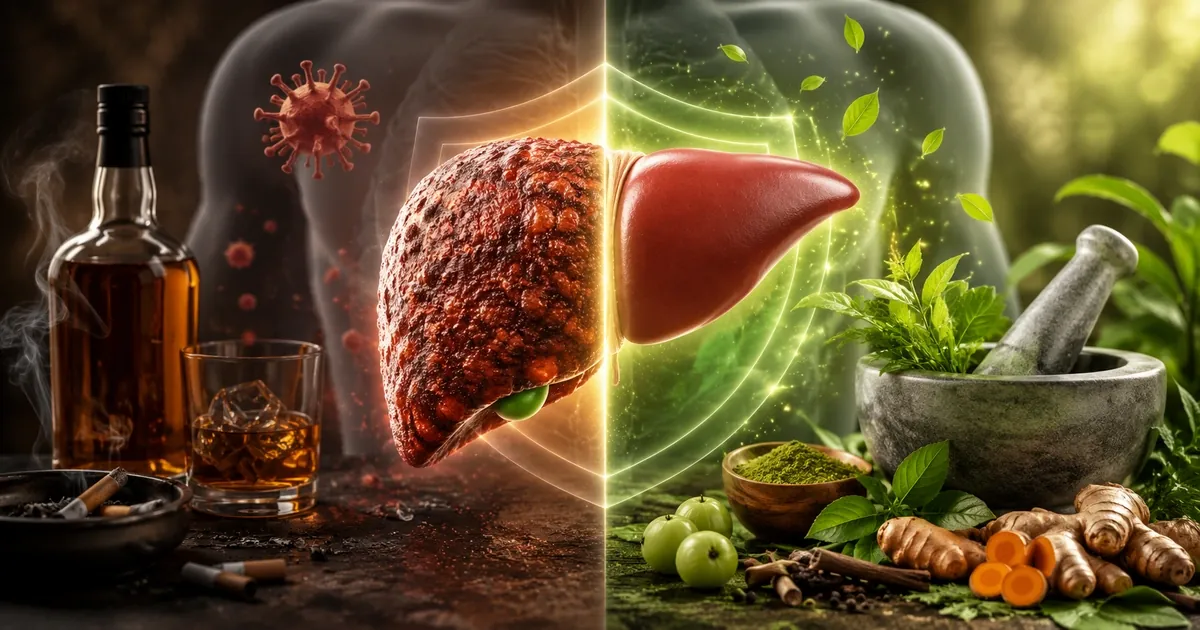
The most common question is whether a tonic can protect the liver while drinking continues. It cannot. Here is what changes the trajectory, and where Ayurvedic care does real work.
People arrive asking for a liver tonic that will let them keep drinking. That product does not exist, and saying so is the most useful thing on this page. What does exist is a set of changes that alter where this goes — and those changes are worth writing down properly.
The honest starting point
The liver metabolises alcohol and repairs itself, and it can do both for a surprising length of time. What it cannot do is repair itself and process alcohol at the same rate indefinitely. Every supportive measure — herbs, diet, medicine, rest — works only in the space that alcohol leaves behind. Fill that space with continued daily drinking and no formulation, Ayurvedic or otherwise, will protect the organ.
This is not a moral argument about drinking. It is a mechanical one about how much work one organ can be assigned.
The three stages, and what each one means
- Alcoholic fatty liver: fat accumulates in liver cells. It is the earliest change, very common in regular drinkers, usually symptomless, and enzymes are often only mildly raised. This stage reverses within weeks to a few months of stopping. It is genuinely good news when caught here.
- Alcoholic hepatitis: the liver is inflamed and liver cells are being injured. People feel unwell — tired, poor appetite, nausea, a tender liver, sometimes fever and jaundice. Enzymes are usually raised with AST higher than ALT, which is the opposite of the pattern in fatty liver caused by weight. Mild cases improve with stopping and nutrition. Severe cases are a medical emergency with real mortality, and they are managed by a physician, not at home.
- Fibrosis and cirrhosis: repeated injury leaves scarring. Early scarring can partially settle when drinking stops. Established cirrhosis does not reverse, and the goal changes from cure to keeping it compensated for as long as possible.
The uncomfortable part is that these stages overlap and can arrive sooner than the number of years someone expects. Quantity and pattern matter more than duration: daily drinking, and drinking to the point of intoxicity, are what drive injury.
What actually changes the trajectory
- Stopping, or in established disease, stopping completely. This is the single intervention with the strongest evidence at every stage, and nothing else on this list substitutes for it.
- Nutrition, taken as seriously as the liver itself. Regular heavy drinking displaces food, damages the gut lining, and blocks the absorption and use of several nutrients. Protein and calorie deficit, thiamine, folate, vitamins A, D and E, and zinc deficiency are common, and they make both the liver and the recovery worse. Rebuilding food is not a soft addition here; it is part of the treatment.
- Hepatitis B and C status, and vaccination where indicated, because a second liver hit on top of alcohol is much worse than either alone.
- Reviewing every other medicine and supplement with a doctor, including painkillers and herbal powders, because an injured liver handles them differently.
- Not mixing alcohol with paracetamol-containing medicines, which is a specific and entirely avoidable way to cause acute injury.
Where Ayurvedic care does real work
The honest list is narrower than advertised, but it is not empty:
- Rebuilding appetite and digestion. Food refusal, early fullness, bloating and loose motions are common in this group, and a plan that actually gets calories and protein into the day is worth more than any liver supplement.
- A food pattern an Indian household can keep: regular timings, real protein at each meal, enough to correct the deficit without overwhelming a poor appetite.
- Weight, sleep and daily routine, which are usually in disarray, and which decide whether the plan survives past two weeks.
- Supporting the gut. Alcohol injures the intestinal lining, and the digestive complaints that follow — gas, loose motion, bloating — are where Ayurvedic digestive care is most useful.
- Structured follow-up. The person who comes back every three weeks for weight, appetite, enzymes and a straight conversation does better than the person who buys a course and disappears.
- A few herbs with modest evidence as support for liver enzymes and inflammation. Modest is the word. They are the smallest lever here, and they are never offered as permission to keep drinking.
What we will not do
- We do not sell a liver tonic that lets someone continue drinking. That is the product this page exists to refuse.
- We do not treat alcohol dependence with herbs. Craving and withdrawal are medical problems, and pretending otherwise is how people get hurt during withdrawal.
- We do not promise that established cirrhosis reverses. We promise to keep it compensated longer, and we measure whether we manage that.
- We do not stop a hepatologist medicine, diuretic, lactulose or beta-blocker that someone is already on.
- We do not send people to buy unlabelled powders. There are documented cases of herbal products causing liver injury outright, and an already injured liver is the worst place to experiment.
If the drinking is the hard part
For someone drinking heavily every day, stopping suddenly is a medical event, not a resolution. Withdrawal can produce tremor, sweating, anxiety and insomnia, and in its severe form seizures or confusion. That is dangerous. It needs a doctor, sometimes medication, and in some cases a supervised inpatient stop. Please do not attempt a cold stop alone if you drink daily, if you have withdrawn before, or if you now need a drink in the morning to feel normal.
What we can do is take this seriously and without lecture, run the liver workup alongside it, and keep the nutrition and follow-up part going whatever else is happening. Recovery is a medical process; the liver simply does better inside it.
Tests that answer something
- AST, ALT and GGT: the pattern here is usually AST above ALT, and GGT is the sensitive one for alcohol-related injury.
- Bilirubin, albumin and platelet count together: how well the liver is still functioning, and a cheap first estimate of scarring.
- Clotting tests: the liver makes the proteins that keep blood clotting properly, and when those run long, the liver is struggling.
- Complete blood count, B12 and folate: the nutritional damage usually shows up here before the liver numbers do.
- Ultrasound, and a stiffness measurement when scarring is suspected: fat, surface, size, and whether fibrosis needs excluding.
- Hepatitis B and hepatitis C testing: because a second cause changes the whole plan.
Signs the liver has stopped compensating
- Yellow eyes and skin, dark urine, pale stools.
- A swollen, tense abdomen, or leg swelling that is new and increasing.
- Confusion, reversed sleep, slurred speech, or uncharacteristic drowsiness. This is an emergency.
- Vomiting blood, or black tarry stools. Emergency care, immediately.
- Fever with abdominal pain and tenderness.
- Easy bruising, or bleeding from the gums that never happened before.
At our two centres
- Model Town and Burari, first consultation free. We read the enzymes, the function tests and the scan together, work out which stage this is, and put the food, protein, timing and follow-up plan in writing.
- Where dependence is part of the picture we treat it as a medical problem and route it to a physician rather than handling it with herbs. Where advanced disease, hepatitis or decompensation appears, we run alongside a hepatologist and keep our own work to nutrition, digestion and follow-up.
Every individual is different. Before trying any new remedy or routine, please consult a qualified Aksa Ayurvedic doctor so the guidance can be personalised to your body constitution and health condition.
Related reading
Paracetamol और liver damage — कितनी dose पर खतरा
Read
Fatty Liver और आपकी 9-5 नौकरी — आयुर्वेद से इलाज
Read
Fatty Liver में ghee खाएँ या नहीं — आयुर्वेद और modern science
Read
Fatty liver: the lifestyle and diet changes that reduce it
Read
Grade 1 Fatty Liver — दवा के बिना reverse हो सकता है
Read
Liver का दर्द दाईं तरफ नहीं, दाहिने कंधे में — छिपा हुआ संबंध
ReadTake the next step on your own case
Aksa physicians have been consulting on Ayurvedic care since 1992. Book a free video consultation and get a routine built around your digestion, sleep and history.