
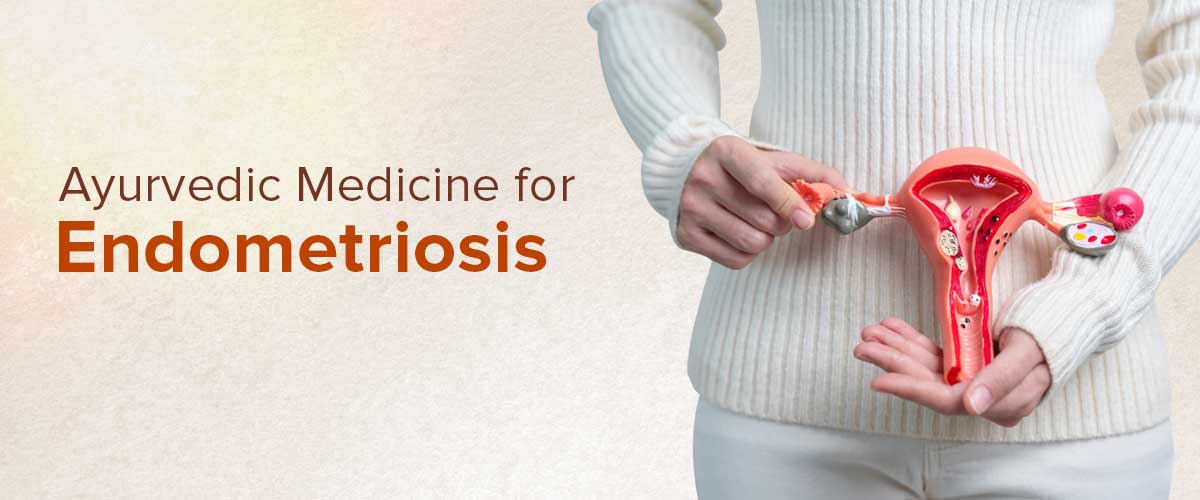
Endometriosis is a structural, hormone-driven disease, and no herbal preparation removes an implant. What medicine can reasonably be asked to do is reduce the pain, blunt the flare each cycle, and keep you functioning between the decisions that a gynaecologist has to make.
What the medicine is for, and what it is not
- It is for the pain: cycle pain, back pain, the deep pain with intercourse, the gut pain that makes a period an exercise in endurance.
- It is for the fatigue that comes from months of bad sleep and regular bleeding.
- It is not for the lesions. Tissue that has implanted outside the uterus does not dissolve because of a tablet, and anyone claiming it does is being read a marketing line.
- It is not for a cyst that needs draining, an ovary that has twisted, or adhesions that have changed the anatomy. Those are surgical questions.
- Being clear about this is not pessimism. It is what allows the medicine to be judged honestly, on symptoms, rather than on a scan that will look the same either way.
What we prescribe
- Kalyanaka guggulu, the classical guggulu preparation built around menstrual pain and irregularity. It is the one most often at the centre of an endometriosis course.
- Ashoka, usually as an arishta or a decoction, where bleeding is heavy and prolonged.
- Dashamoola kwath for the deep aching, the lower back, the pelvic heaviness. A ten-herb root decoction, and one of the better tolerated long-run options.
- Punarnava where there is swelling and a puffy morning, with the kidneys checked first.
- Guduchi as a general anti-inflammatory support through the course.
- Ashwagandha for the exhaustion and the broken sleep, which is often the part patients say helped most.
- Iron and nutrition where the counts have run down from long, heavy cycles.
- Pain relief at the right time rather than at the worst time. Waiting until the second day of a brutal cycle is a well-known reason these courses fail.
- None of this is a fixed packet. The combination changes with the picture, and it is reviewed cycle by cycle.
What we are careful with
- Endometriosis is oestrogen-driven. Shatavari and other phyto-oestrogenic herbs, which sit in almost every standard female formulation, are not automatically right here. They are used deliberately, if at all, and not by reflex.
- Licorice is limited where blood pressure is a problem. Long courses of some guggulu preparations need liver and kidney checks.
- Anti-platelet and blood-thinning herbs are avoided around surgery, and stopped in advance of it on the surgeon's instruction.
- Where a hormonal treatment is being used, dienogest, a progesterone, a levonorgestrel coil or a GnRH agonist, the herbal course is planned alongside it, not in place of it. Bone density on GnRH treatment is a real concern and needs its own monitoring.
- Painkillers taken daily for months are their own problem: stomach, kidneys, and rebound headache. Reducing that load is a legitimate goal of the course.
Where it fits with hormones and surgery
- Hormonal treatment suppresses and quiets the tissue. It is the conventional first move, and it works for many people.
- Laparoscopy confirms the diagnosis and removes what can be removed. It also improves fertility in some cases, and it is not a cure, because the disease commonly returns.
- Ayurvedic medicine in this picture is an add-on for symptoms and for the intervals between treatments. It does not replace either of the two things above.
- If a plan is being changed, the reason should be a symptom that is not controlled or a side effect that is intolerable, and it should be a decision made with the gynaecologist who is managing it.
The fertility question
- This is the hardest conversation on the page, and the one where honesty matters most.
- Endometriosis affects fertility through anatomy, through inflammation, and sometimes through ovarian reserve, particularly after surgery on an endometrioma.
- Herbal medicine does not open a blocked tube, does not restore a diminished ovarian reserve, and does not substitute for IUI or IVF.
- What it can do is improve the general picture: sleep, pain, weight, appetite, and the ability to keep going through a treatment cycle.
- If conception is the goal, get a reproductive opinion early rather than after two years of courses. Age and ovarian reserve are the variables that do not wait, and time spent on something that cannot fix the anatomy is time lost.
- No one here will promise a pregnancy. People who do are the reason some patients arrive late.
When to be seen without waiting
- Sudden severe pelvic pain with fever or vomiting. Infection, a ruptured cyst, or a torsion, all of which are emergencies.
- Bleeding that floods, soaks through quickly, or comes with dizziness and a racing pulse.
- Pain so severe that it is not controlled by what has been taken, or a first episode unlike the usual cycles.
- Vomiting with abdominal distension and no wind passing, which can be an obstruction from adhesions.
- A positive pregnancy test with one-sided pain and bleeding. An ectopic pregnancy has to be excluded immediately, and endometriosis is one of its risk factors.
How long, and how we judge it
- Three cycles is the shortest fair review. Pain is cyclical, so a change measured in days means very little.
- We judge it on a diary: days of pain, days of bed, painkillers used, and what was given up. That is more useful than any single score.
- Scans and CA-125 are not used to judge a herbal course. They do not track this reliably, and a stable scan alongside better functioning is a good result.
- If three cycles produce nothing, the medicine is changed or stopped, and the conventional pathway gets more attention rather than less.
- The daily things are not optional: heat early in the cycle, movement that keeps the pelvis from stiffening, sleep protected, and iron replaced if the periods are heavy. These are the parts of the plan that cost nothing and are most often skipped.
ShareWhatsApp
More medicines
Ayurvedic medicine for fat loss: what it can and cannot do
Read
Ayurvedic medicine for gout: bringing uric acid down
Read
Ayurvedic medicine for liver cirrhosis: support, not reversal
ReadAyurvedic medicine for diabetes: how it fits with your sugars
ReadAyurvedic medicine for cough
ReadAyurvedic medicine for fever
ReadAsk a physician before you start
Aksa physicians have been consulting on Ayurvedic care since 1992. In a free video consultation they will tell you which formulation fits your case, in what dose, and whether it suits the treatment you are already on.