
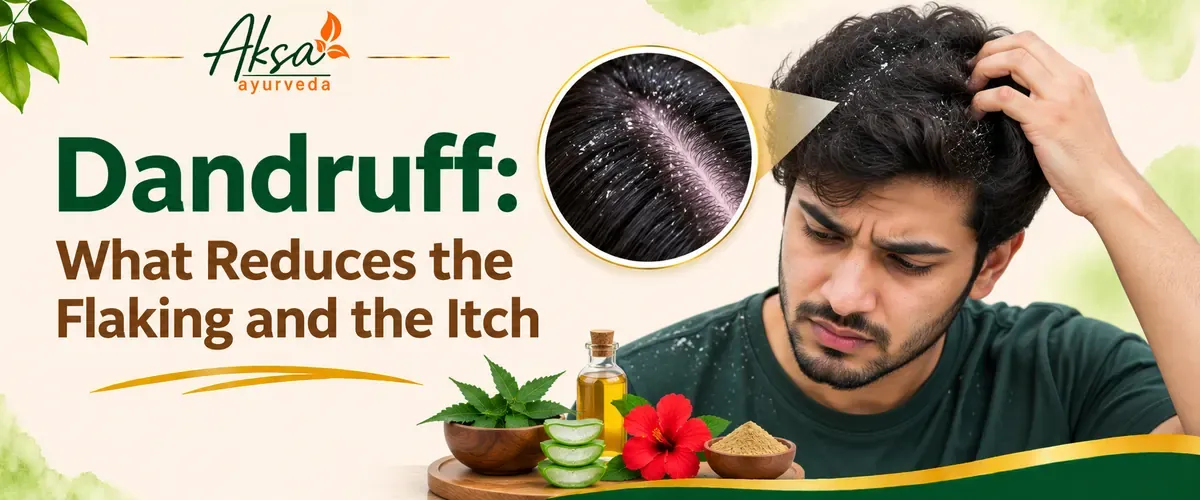
Dandruff is scalp skin shedding faster than usual, and it settles with a routine you keep rather than one treatment. Here is what reduces the flakes and the itch, and when it is not dandruff.
Why the scalp flakes
The scalp renews its surface continuously. In dandruff that renewal speeds up and the cells come off in visible clumps instead of invisibly.
Three things drive it, usually together.
- Sebum. The oil the scalp produces feeds a yeast that lives on everyone's skin, and in some people the immune system reacts strongly to it.
- That reaction, which inflames the surface and speeds up shedding. It is not a hygiene failure and it is not contagious.
- Irritation on top of it: harsh shampoo, scratching, hot water, product build-up that is never washed out properly.
It worsens in winter and in dry, heated rooms, and after long gaps between washes. Oiling the scalp heavily and leaving it overnight often makes it worse rather than better, because it feeds exactly the organism involved.
The wash routine that works
- Use a medicated anti-dandruff shampoo two or three times a week. Rotate between two different active ingredients if one stops helping.
- Lather it into the scalp, not the hair lengths, and leave it on for three to five minutes before rinsing. Rinsing immediately is why good shampoos look useless.
- On the other days, use a plain mild shampoo or water alone.
- Wash with lukewarm water. Hot water leaves the scalp itchy and reactive.
- Dry the scalp before tying the hair or putting on a cap. A damp scalp under a helmet or a turban for hours is a common cause of a relapse.
- Comb from the ends upward, and never scratch with the nails.
What to stop doing
- Overnight oil massage every week. If oiling helps you at all, keep it to thirty minutes before washing and use very little.
- Lemon juice, undiluted vinegar, toothpaste or baking soda rubbed into the scalp. They sting, inflame and often worsen the shedding.
- Scratching, which creates the itch-scratch loop and small scabs that get mistaken for something worse.
- Washing every day with a strong shampoo, which strips the scalp and increases oil production.
- Sharing combs, towels or caps, and leaving pillowcases unchanged for weeks.
- Applying someone else's steroid lotion near the hairline for months. It thins the skin and rebounds harder.
Habits that change the frequency
- Wash after heavy sweating rather than waiting for the scheduled day.
- Keep the scalp uncovered in strong sun, or use a cap outdoors, but let it breathe afterwards.
- Sleep and stress both show up on the scalp. Flares commonly follow a bad stretch rather than a bad shampoo.
- Check iron and zinc status if hair fall accompanies the flaking. Dieting hard is a common trigger in both.
- Change the pillowcase twice a week during a flare, and wash caps and helmets.
When it is not dandruff
These need an examination and usually a medicine, not a routine.
- Thick, well-defined silvery plaques above the hairline, behind the ears or on the elbows. That pattern suggests psoriasis.
- Round bald patches with fine scaling and broken hairs, especially in children. That is a fungal infection and needs oral treatment; no shampoo clears it.
- A weeping, crusted, foul-smelling scalp, or one with tender lumps.
- Flaking with significant hair loss, or with a rash on the face, chest or eyebrows.
- Severe itch with no visible scale, which may be lice, or an allergy to a hair product or dye.
- An infant with thick yellow crusts on the scalp — handle gently and get advice rather than picking at it.
- Any scalp problem with fever, or swollen glands at the back of the neck.
How long to give it
- A proper routine usually settles visible flaking in two to four weeks.
- Dandruff comes back. It is managed, not cured, and the shampoo that worked at the start is often the one that works again after a break.
- Once controlled, using the medicated shampoo once a fortnight prevents most relapses better than restarting treatment after three weeks of flakes.
An Aksa physician looks at the scalp itself before assuming dandruff, because the three conditions above are treated quite differently — and then works at the pattern behind the flare: digestion, sleep, stress, season and what has been applied to the scalp over the years. Both Delhi clinics examine the scalp in person, and the video consultation is free.
Every individual is different. This page is general education, not a prescription for you, and it cannot replace an examination.
More home remedies


Ask whether this remedy fits you at all
In a free video consultation an Aksa physician reads the complaint against your digestion, sleep and history, and tells you plainly what a home remedy can and cannot do for it.